
How can we find new ways to honour the Living Wash?
An exhibition at the Old Coastguard Station, Gibraltar Point National Nature Reserve, Gibraltar Rd, Skegness, PE24 4SU
Open Saturday 17 – Sunday 25 October 10.00 – 3.00
Drop-in workshops for children & families
On Sunday 25 October 11.00 – 12.30 & 1.30 – 3
Just turn up – no need to book
Katie Bliss and Rosy Prue will be running some drop-in practical workshops for children and families all designed as a way to explore the local landscape in different ways: – painting with mud and gelli printing from shells and plants. Free and materials provided
The exhibition
Katie Bliss, Sara Heywood, Rosy Prue, Jane Sarre
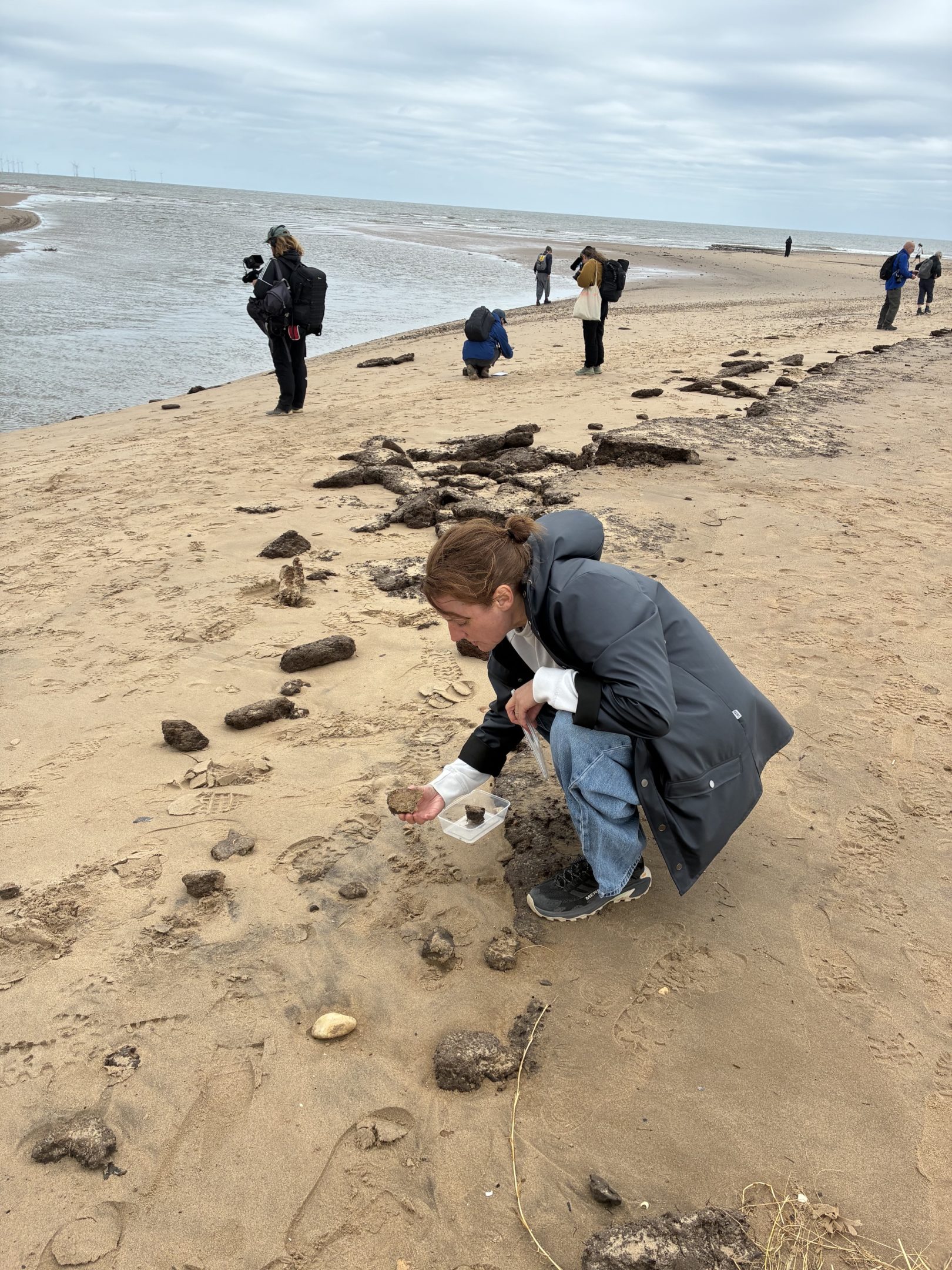
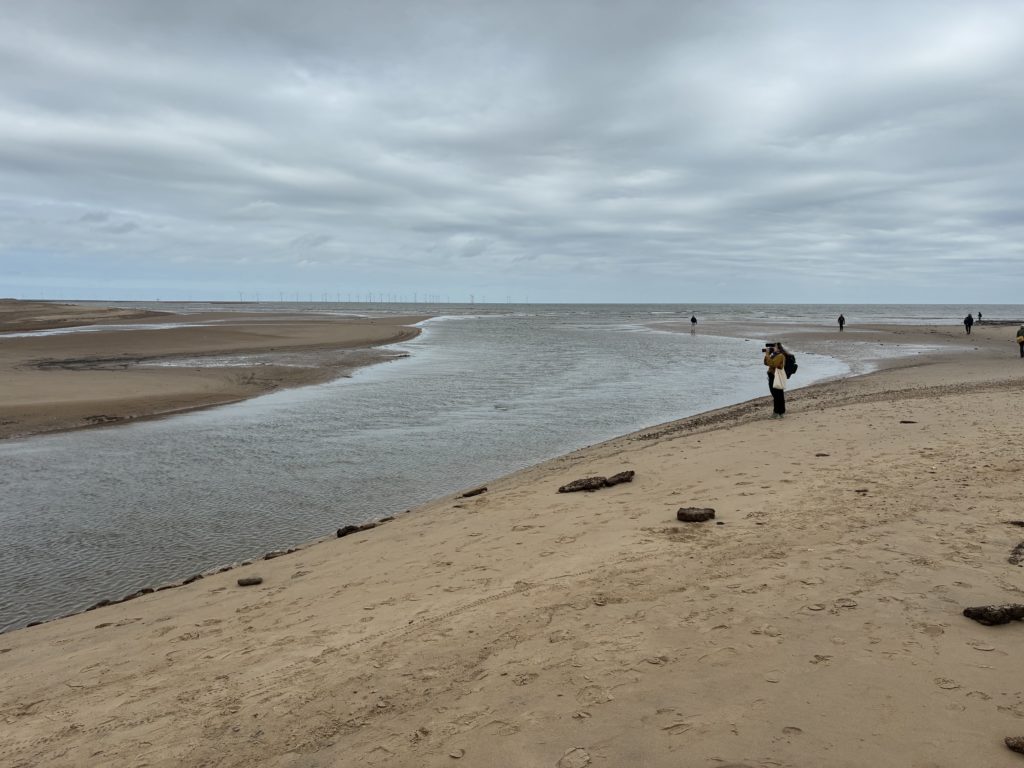
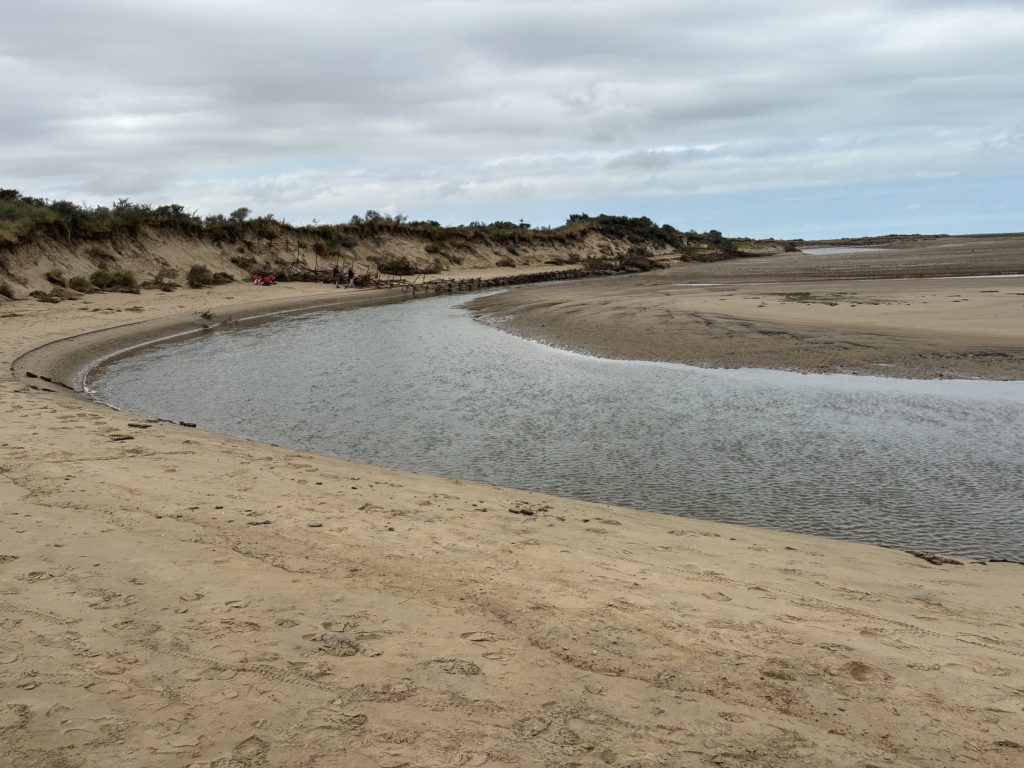
We visited Gibraltar Point with all 27 artists during the Wash residency research week. The landscape at Gibraltar Point captivated us all. From the visitor centre and café walking across the marshes, there are quietly beautiful views across a softly varied landscape . As everywhere at the edge of Eastern England there are vast skies which create a real sense here of joining with the earth so the whole landscape feels broad and extensive. But it is at the shore-line where one really experiences the special qualities of Gibraltar Point. There, over the dunes where salt-marsh meets the sea one feels, as one is, right at the northern edge of the Wash. Quite a few artists revisited, sometimes time and again. and a remarkable body of experimental work was the result.
Sara Heywood
Over Flow, 2026
For over 400 years, humans have attempted to control the flow and distribution of water that moves in and out of The Wash Estuary, its surrounding river systems, and low lying land. As a result the ground has subsided. But sea levels are also rising. In a complex landscape at risk of repeated flooding, questions arise about how best to future manage this unique environment. Do we continue to attempt to control through ever increased drainage management and sea defences? Left to its own devices, within only one year The Wash could reclaim over 1,300 square miles of surrounding fertile land.
Through a series of alternative photographic processes, Over Flow responds to this landscape at a key point in its history. Where fragile, intertidal ecosystems and man exist in precarious balance. Working with locally sourced materials, The Estuary has also become co-author of the artwork. Over Flow records an environment that is constantly shifting, releasing and reconstituting itself.
“The act of making in a darkroom or in situ forces me to flood and wash the paper repeatedly, rhythmically, mindfully. It’s also a fragile environment – part control, part letting go and allowing the processes and materials to dictate the outcome.”
Sara Heywood is a British multidisciplinary artist. Her practice focuses on site responsive, process driven interventions where natural and manmade environments and materials collide. Intrinsic to the work is an urgent dialogue between humans, heritage and environmental land legacy.
Heywood has exhibited in the UK and abroad, undertaken international residencies and commissions including at PADA Studios, Lisbon, & Orford Ness, Suffolk, and was short-listed for 7th John Ruskin Prize (2025) for Camera Obscura – Hertford Union Canal. Her socially engaged commissions include Mulberry Tree of Plenty (UCL Trellis), Greenhouse & Bird Hide (Bow Arts Trust), and Reflections on Home (Artscape Management).
Rosy Prue
She Contains Multitudes
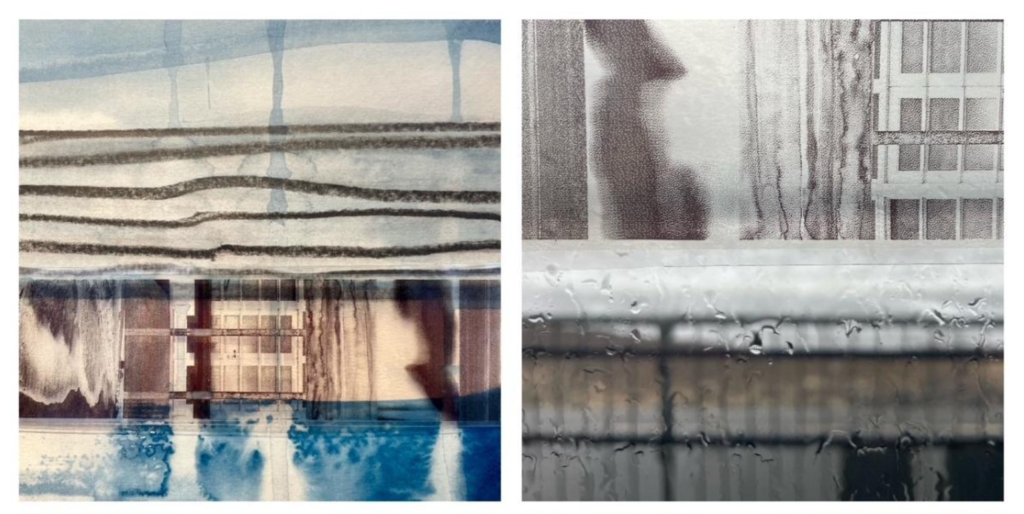
A series of test panels for a digitally printed fabric piece in which The Wash’s dynamic landscape, ecological richness and shifting boundaries become both source material and metaphor for states of flux, permeability and potential.
The work invites suggestion of The Wash not simply as a place, but as a body – a threshold space that contains, absorbs, releases and transforms. Its tidal rhythms and cycles of immersion and emergence subtly echo the female body: fluctuating rather than fixed, simultaneously holding multiple states, stories and possibilities.
Photography and physical art processes are layered creating a surface that is both descriptive and abstract, where different aspects accrete and merge, are obscured and revealed.
The suspended fabric further evokes skin and membrane – a sense of protection, concealment, yet porosity. Both solid and fluid, visible and hidden.
Rosy Prue’s practice explores layers and liminality, both physical and conceptual, using superposition as both method and metaphor.
Often working in the intersection between analogue and digital she combines handmade elements (including printmaking, drawing, painting and photography) with low-tech (using digital processes to combine and transform), retaining the imperfect, intuitive mark of the maker.
Her work is drawn from an engagement with nature, place, history and lived experience.
Jane Sarre
During the residency, Jane Sarre immersed herself in different wetland habitats, following her practice of being with, absorbing and looking closely before drawing the different plant communities she found in each. The flow of attention and line following the adaptations she observed plants exhibiting in order to thrive in these changeable soft places.
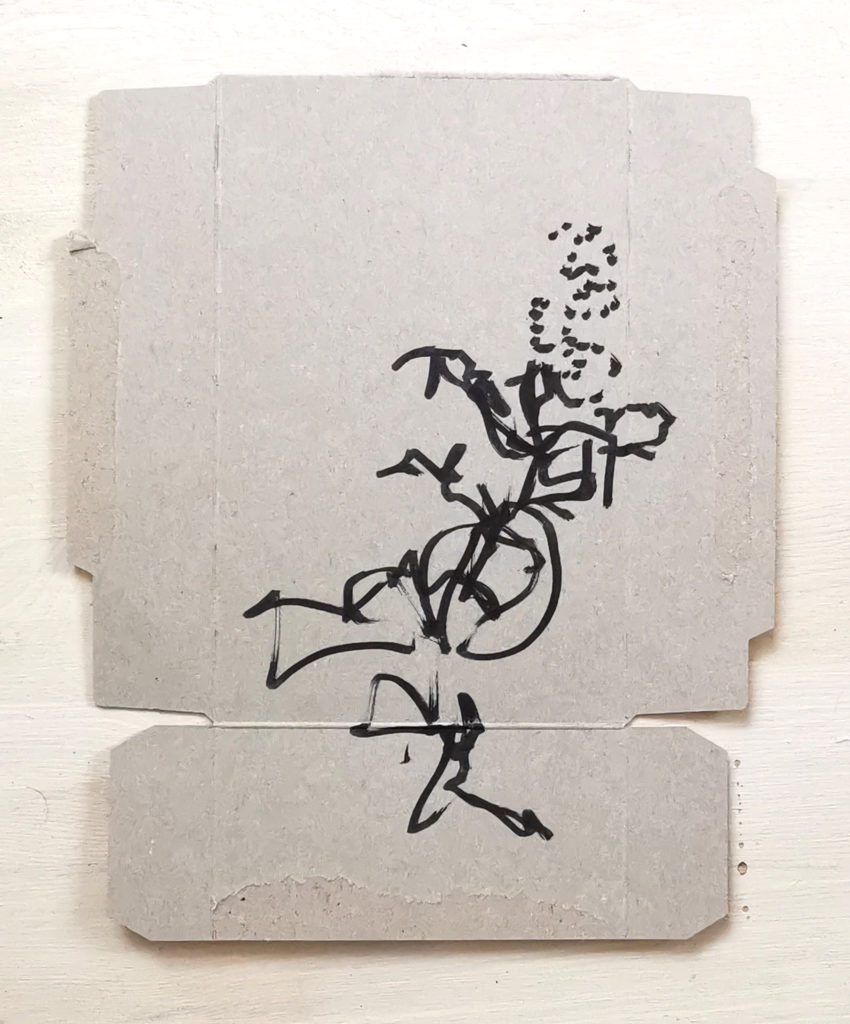
Hard hit by the terrible peat fire at Holme Fen which prevented her intended visit, and by the dryness of the drained Fen lands, she was forced to accept change, spend time being with her responses to those events and experiences, processing grief and a sense of powerlessness in order to find a viable next step.
Maintaining her relationships with the places where she spent time, she has worked directly into the collections of drawings so they became both record and object. Using fire and water in actice interplay with the collated papers she mirrors the complex natural, and human intervention-driven, dynamic processes of the Fen and Wash ecosystems.
The resulting work becomes a collection of offerings to the waters of these four great river catchment areas, offering both past practices and future possibilities in the forms of relating we might render towards these life-giving waters. In doing so it raises questions about the choices we make in thinking about and acting towards these watery places, whilst the plants recorded in the drawings become contingent on those questions and answers.
Dr Jane Sarre works in a slow ferment of walking, relational presence and time, finding de-conditioned ways of being with and connecting to places and their ecosystems. She gathers reclaimed, responsibly foraged and sourced materials and works across drawing, text, sculpture, installation, action and film. Drawing on a lifetime fascination for places and her experience of archaeology, geography and social history, her work aims to function as medicine for un-loved places, seeking non-extractive and even regenerative practices that renew the ecology of place and it’s cultural vitality as well as her own personal well-being. In doing so she offer invitations to the viewer to see afresh, reconsider and find their own new connections.
Katie Bliss
Ancestral Futures
This work envisions The Wash as a living being, macro to micro. A multi-species organism connecting past and future. An imagined ritual landscape revering its more-than-human wisdoms.
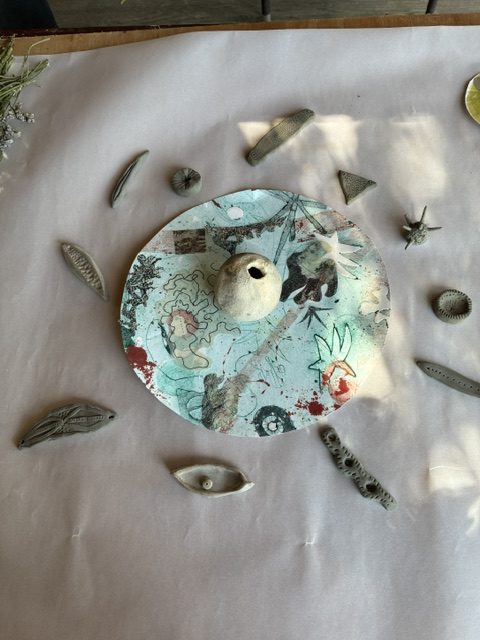
Benthic Beings
Formed from wild clay that was once an ancient saltmarsh, now lying deep under her family farm in the Fens.‘ Benthic Beings’ hold the memory of this watery land. The clay becomes playful ritual objects which revere the world-building of mud microbeings and their interspecies collaborations. Diatoms are single celled organisms which collectively create a photosynthetic skin on mudflats in the Wash. Absorbing carbon and enhancing flood resilience. Gathering sediment and growing saltmarsh with each tidal breath.
Katie Bliss is creatingmixed media works which combine wild clay, botanical inks and soil pigments, photographs and sound gathered from the Wash. Animating the language and agency of meandering saltmarsh creeks and roddon echoes in reclaimed farmland. Listening to intertidal vegetal bodies, translating their electrical fluctuations into musical notes and graphic scores.
This work in progress provides a starting point for ongoing enquiry: What can we learn from more-than-human beings about about cohabiting the Wash?
Katie Bliss is an agroecologist and multi-disciplinary artist exploring the intersection of ecology, imagination and animism. Playfully listening from non-human perspectives, she seeks to cultivate collective imaginations that can dream into resilient future landscapes.
Her practice includes working with farmers and communities to grow, experiment and codesign future ecologies. She creates with bioacoustics, gathered materials, alternative photography, collage and installation. Working with a family farm in the Fens situates her in the tension between cultivating multi-species empathy whilst sustaining our human communities.
